Capital Efficiency in a Higher-Yield Era: Strategies for Corporate Resilience
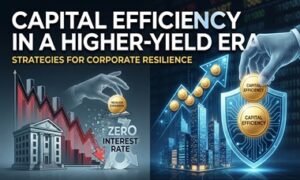
Navigating an economic climate defined by rate normalization and elevated borrowing costs requires a complete departure from the “growth at all costs” mindset of prior zero interest rate cycles. With long-term Treasury yields and policy rates settling at higher levels, corporate capital allocation faces intense scrutiny from investors, boardrooms, and lenders. In this environment, the cost of capital is no longer an afterthought; it is a central variable that directly dictates valuation multiples, expansion feasibility, and survival.
For modern enterprises and financial planners operating through webtoolpro.com, optimizing capital efficiency is no longer just a defensive maneuver—it is the primary driver of sustainable, long-term enterprise value.
- The New Mechanics of Corporate Borrowing and Refinancing
As earlier low-rate debt maturities come due across global markets, businesses are forced to refinance in a structurally tighter debt market. This shift mandates a rigorous, unsparing approach to balance sheet management and debt structuring.
- Shorter Durations and Adaptive Covenants: Issuers increasingly favor flexible, shorter-term debt structures and adaptive covenants to maintain strategic maneuverability amid ongoing market volatility. Locking into long-term debt at historically elevated rates carries significant opportunity costs if monetary easing materializes later.
- The Rise of Private Credit: With traditional commercial lenders exercising tighter risk parameters, mid-market companies and sponsor-backed organizations are turning heavily to private credit markets to bridge liquidity gaps and finance targeted capital expenditures.
- Disciplined Capital Allocation: Borrowing decisions are now strictly strategic—tied directly to high-ROI infrastructure, critical software upgrades, or essential mergers and acquisitions rather than speculative, opportunistic expansion. Every dollar of borrowed capital must prove its immediate utility to the bottom line.
- Operational Levers for Maximizing Capital Efficiency
When the cost of capital remains elevated, internal financial optimization takes center stage. Because external financing is expensive, organizations must look inward, deploying key operational levers to protect operating margins and fund growth organically.
- Working Capital Optimization: Streamlining inventory turnover, tightening accounts receivable cycles, and aggressively managing cash conversion cycles ensure that internal cash flow, rather than expensive external debt—funds day to day operations. Reducing days sales outstanding (DSO) acts as an immediate, risk-free liquidity injection.
- Rigorous AI & Technology ROI Audits: Following massive waves of experimentation, corporate leadership is demanding clear, measurable returns on technology investments. Infrastructure spending—particularly around data centers, cloud resources, and AI automation—must demonstrate a direct line to productivity gains, labor cost offsets, or revenue acceleration.
- Data-Driven Financial Forecasting: Eliminating data silos across enterprise resource planning (ERP) systems and subledgers allows finance teams to run real-time variance analyses, accurately predict cash crunches, and pivot capital instantly when macro conditions shift. Visibility is the ultimate currency of capital efficiency.
- Rethinking Capital Expenditures and Strategic Expansion
Capital expenditure (CapEx) strategies have undergone a radical transformation. In a low-yield environment, companies could afford to fund sprawling, long-term research or multi year infrastructure projects with minimal near-term accountability. Today, capital budgeting requires a modular approach.
- Phased Milestone Funding: Rather than committing full project budgets upfront, modern finance teams release capital in tightly monitored tranches based on predefined operational milestones. If a digital transformation project or a new production line fails to meet interim velocity or efficiency targets, capital is reallocated or frozen.
- Asset-Light Business Models: Organizations are actively evaluating whether owning physical assets is truly necessary. Leasing, software-as-a-service (SaaS) models, and strategic outsourcing allow companies to convert fixed capital expenditures into variable operating expenses, preserving cash for core competencies.
- Strategic Takeaways for Business Leaders and CFOs
In a higher-for-longer yield environment, market rewards flow toward companies that demonstrate long term operational discipline, transparent disclosures, and cash flow durability. By shifting the strategic focus from top-line revenue chasing to bottom-line efficiency, businesses can insulate themselves against macro shocks.
Ultimately, capital efficiency is not a temporary fix for high interest rates; it is a permanent upgrade to corporate discipline. Organizations that master this transition will emerge stronger, more agile, and structurally superior as economic and market cycles continue to evolve.